
Quantum Revolution: Computing Beyond Classical Limits
Quantum computing stands to redefine problem-solving across industries, delivering substantial improvements in speed and capacity. This course examines the current state of the field, its anticipated impact on cybersecurity, and the importance of preparing for both its promise and its risks.
What you will learn
-
Grasp the principles of quantum mechanics as they apply to computing.
-
Explore the potential applications and future impact of quantum computing.
-
Understand the current state of quantum computing technology and its challenges.
Course content
Basics of Quantum Computing
Cover the foundational principles of quantum mechanics in computing.
Quantum Computing Today
Examine current quantum computing technologies and their applications.
Future of Quantum Computing
Discuss the future possibilities, challenges, and impact of quantum computing in various fields.
Your Course Director
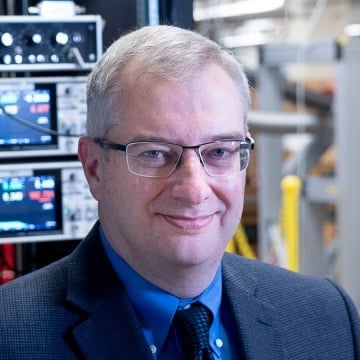
Dr. Michael Manfra
Bill and Dee O’Brien Distinguished Professor of Physics and Astronomy
Professor Manfra joined the faculty of Purdue in 2009 after working for 10 years in the Semiconductor Physics Department of Bell Laboratories in Murray Hill New Jersey. He obtained his PhD from Boston University in 1999 and his AB degree from Harvard University in 1992. His current research interests include molecular beam epitaxy of ultra-high purity semiconductors, topological phases of matter, electronic transport at low temperatures and high magnetic fields in mesoscopic structures and quantum computing. When not in the laboratory, Prof. Manfra can be found in his woodworking shop turning fine lumber into sawdust.